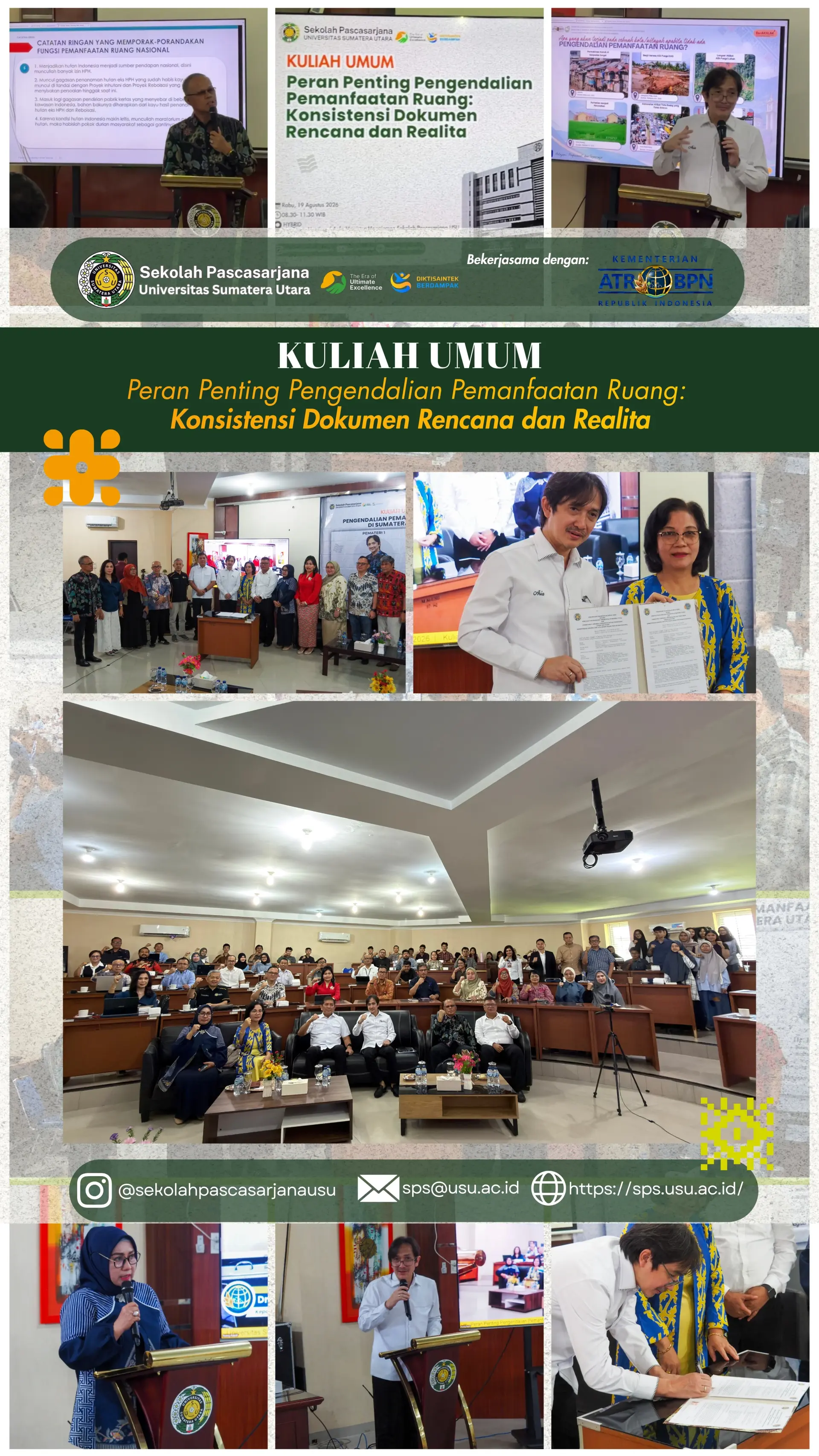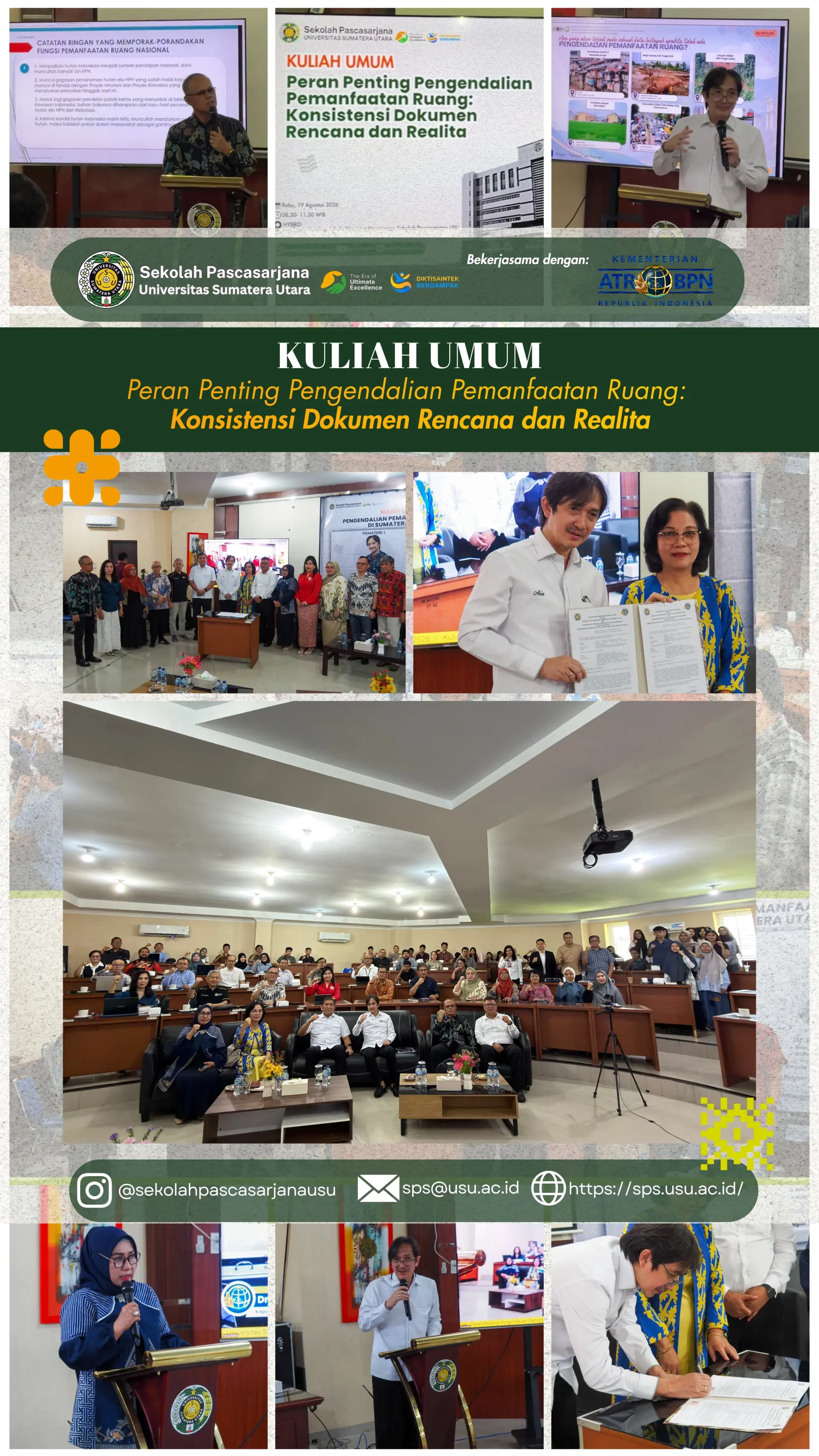
The Doctoral Program in Regional Planning together with the Master's Program in Regional and Rural Development Planning under the Graduate School of Universitas Sumatera Utara (USU) successfully hosted a Public Lecture carrying the theme "The Crucial Role of Spatial Use Control: Consistency Between Planning Documents and Reality." Organized in partnership with the Ministry of Agrarian Affairs and Spatial Planning/National Land Agency (ATR/BPN) of the Republic of Indonesia, the event took place seamlessly on Wednesday, August 19, 2026, from 08:30 to 11:30 WIB.
This academic program was conducted in a hybrid format, allowing participants to attend in person at the Master of Management Hall, Graduate School USU, or virtually via the Zoom Meeting platform. The public lecture was integrated with the formal signing of an Implementation Agreement (IA) for collaborative activities between the Graduate School of USU and the Directorate General of Land and Spatial Control and Enforcement (Ditjen PPTR).
Moderated by Isnen Fitri, S.T., M.Eng., Ph.D., the presentation session proceeded interactively featuring two main keynote speakers:
Aria Indra Purnama, S.T., MUM (Director of Spatial Use Control, Ditjen PPTR), acting as Speaker I, delivered a presentation on "Spatial Use Control in North Sumatra." He addressed the practical implementation of incentives and disincentives across Indonesia as well as land consolidation strategies to optimize agricultural land.
Dr. Ir. Munir Tanjung, MM (Environmental Engineering Lecturer and Former Secretary of BAPPEDA North Sumatra), serving as Speaker II, presented on "Formulating Spatial Patterns Based on Central Government Policies." His session highlighted operational challenges in field-level spatial control, including ill-defined boundaries, limited public understanding of spatial functions, land-use conflicts, and sub-optimal legal enforcement.
Participant enthusiasm was evident throughout the interactive Q&A session, where attendees engaged directly in dialogue with the speakers. The event series initiated by both regional planning study programs concluded smoothly, offering practical and academic insights into aligning spatial planning documentation with on-the-ground development realities.
This initiative directly aligns with Sustainable Development Goals SDG 11 (Sustainable Cities and Communities) through integrated urban and regional spatial planning, SDG 15 (Life on Land) through sustainable land management, and SDG 17 (Partnerships for the Goals) by strengthening institutional collaboration between academia and government authorities.