


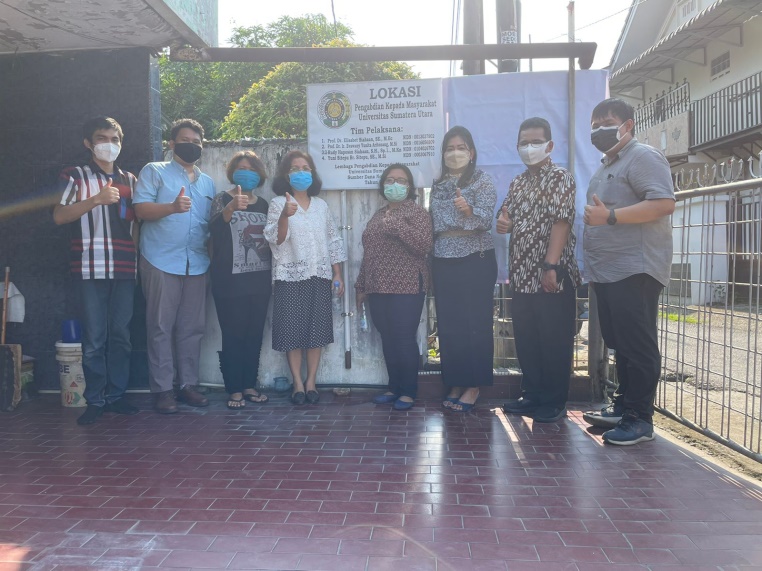
Medan: To continue to have an impact and benefit the community in Medan, Professor Mengabdi's Team carried out community service for micro-businesses in the Medan area. This team consisted of lecturers from the Faculty of Economics and Business, the Faculty of Public Health, and the Faculty of Law, as well as students from the Faculty of Economics and Business and the Master of Property Management and Valuation program at USU. The community service was conducted with Queen's Burger, located at Jl. Tomat No. 14, Medan Baru. This partner produces various nutritious snacks such as burgers, kebabs, sausages, risol, french fries, donuts, nasi tumpeng, nasi kotak, and various other dishes that can be ordered.
The community service was led by Prof. Dr. Elisabet Siahaan, S.E., M.Ec, and the team members included Prof. Dr. Ir. Evawany Yunita Aritonang, M.Si, Dr. Rudy Haposan Siahaan, S.H., Sp.1.M.Kn, and Yuni Sitepu S.E., M.Si. The community service also involved 5 USU students: Isaac Hansko Supendy, Surya Tanbenia, Khairunisa, M. Zukhri Lubis, and Natalis Pardamean Tamba. Prof. Dr. Elisabet Siahaan stated, "This community service is titled 'Effective Business Strategies and Management to Sustain Small Businesses Amidst the Covid-19 Pandemic'."
Prof. Evawany Aritonang said, "The partner needs assistance due to several issues, namely, 'In terms of healthy and nutritious production processes, the partner still needs guidance to be able to produce food and snacks that are healthy and nutritious.' Prof. Elisabet Siahaan stated, 'The partner needs to be mentored and receive IPTEK (science and technology) transfer in terms of human resource management, as the partner does not yet have a strong human resource management system.' From a legal perspective, Dr. Rudy H. Siahaan stated, 'The partner needs guidance on how to create cooperation contracts in accordance with the law, identify actions that violate consumer rights, manage contract renewals with colleagues, and create a legal system for partnerships.' From a financial management perspective, Yuni Sitepu S.E., M.Si., stated, 'The partner needs to be mentored and trained on how to create financial reports and systematic reports on raw materials, production output, and sales.'"
In the Professor Mengabdi scheme, the contributions given to the partner include the transfer of IPTEK, socialization, training, and mentoring in various aspects, starting from building a strong human resource management system by identifying labor needs, effective recruitment and selection, and the ability to retain potential employees. This will make the human resource management system more systematic and effective. The production process emphasizes health and nutrition, from the aspects of business law and reporting of raw materials, production, sales, and finances, as well as more systematic reporting of raw materials, production, and inventory.
The target outputs of the Professor Mengabdi scheme are as follows: First, the partner has an appropriate employee recruitment system and a proper selection system so that the right and superior employees can be obtained. The partner is assisted in creating interview questions, employee selection techniques, job descriptions, job specifications, and job standards for culinary business employees. The second target output is an improvement in the partner's way of thinking, knowledge, and behavior, as well as the establishment of partnerships with other parties that help the company grow further, and the partner's ability to create employment contracts with employees.
The partner understands the correct production, promotion, and advertising activities in accordance with the law. The partner avoids activities that violate consumer rights. The partner is able to manage contract renewals with colleagues. The partner is able to collaborate with similar businesses while complying with the law. The partner understands how to create a legal system for partnerships. From a legal perspective, the partner is able to prepare business development in accordance with the law. The third target output is that the partner always uses appropriate cooking equipment and healthy food containers (food grade) so that the production results are of higher quality, namely healthier, and make consumers more likely to buy again. The partner is able to redesign the production process to be more systematic, produce more, and faster so that customers do not have to wait long for their orders. The fourth target output is a change in the partner's way of thinking and working in calculating inventory, production, sales, and income. The partner can implement cash flow creation and know how to quickly check financial conditions. The partner is able to create financial reports for the assisted business more accurately and systematically.
"Several target outputs that become indicators of achievement in the Professor Mengabdi scheme include publications in community service journals, mass media, and online publications in the form of YouTube video recordings of community service activities that can encourage and inspire the development of micro and small businesses in Indonesia," said Prof. Elisabet Siahaan.