


.png)
Counterfeit inorganic fertilizers are commonly found in the market, but researchers and practitioners in agriculture have been able to identify counterfeit inorganic fertilizers from the real thing visually. Fake composts have also started appearing in the market, with sales places in ornamental plant sellers. These fake composts generally do not have a trademark let alone a sales license.
Judging from the definition compost is a product of partial/incomplete decomposition of a mixture of organic materials that can be artificially accelerated by a population of various kinds of microbes in warm, humid, and aerobic or anaerobic environmental conditions. Composting is the process of biological decomposition of fresh organic waste, especially by microbes that utilize organic matter as an energy source, under controlled conditions to produce a stable substance such as humus. In the composting process, the natural process is regulated and controlled so that compost can be formed more quickly. This process includes making a balanced mixture of materials, providing sufficient water, regulating aeration, and adding composting activators. Fake compost is sometimes derived from the breakdown of hoarded organic residues, which should only be referred to as organic matter. Compost sold in the market comes from burning waste that has characteristics that are almost similar to compost. Even more dangerous is the sale of litter and humus from the forest floor as compost in the market, where the effect of selling forest floor litter will damage the ecosystem and cause erosion. Several landslides in Karo District, Sidikalang, resulted from the forest floor being cleared so that forest water became water that flowed on the ground surface and carried a number of soil masses.
Several studies conducted by students at the Faculty of Agriculture, Universitas Sumatera Utara, using various composts sold in the market, show the low quality of the compost. The application of compost should affect increasing soil organic carbon levels, but the application of compost that is allegedly counterfeit
20 tons/ha resulted in lower organic matter levels than the soil without compost application. Compost is a source of nutrients for plants, but this is not the case with fake compost. The application of 40 tonnes/ha of fake compost resulted in lower nitrogen nutrient levels in the soil compared to the no compost application, which is scientifically termed nitrogen nutrient immobilization. In line with that, the fake compost also resulted in 13% lower maize plant height than the plant height without compost at 10 tons/ha. The use of commercial compost as raw material for making compost tea (liquid organic fertilizer) was able to increase the highest mustard plant weight by 67.2 g/plant, while the highest mustard plant weight on compost produced by researchers with the same amount was 72.8 g/plant.
Why is waste burned?
Waste burning is practiced by almost all households in Medan City. Some of the reasons for burning waste are that it is the easiest and most cost-effective way to remove waste from around their homes or to get rid of waste fees, and some even make it a habit to burn waste in the afternoon. Most people have no knowledge about household waste management and do not know how harmful burning waste is to health and the environment. In addition, there are no strict regulations and actions from the local government for waste burners, so even people who know waste management still burn waste. In some developed countries, burning waste is considered criminal and sanctioned by imprisonment or fines. For example, the fine for littering or burning waste in Singapore is up to 5000 Singapore dollars or around 50 million or a prison sentence of 3 months.
The result of burning waste in the garbage bins will accumulate, the local name is burnt soil. Considering the diversity of waste burnt, household waste burning in Medan City has the potential to produce dioxin. Some people collect this burnt soil and sell it as compost because the characteristics of this burnt waste are very similar to compost. Even ordinary people think burnt garbage bins' soil is a fertile planting medium.
How dangerous is fake compost?
The combustion process of organic matter produces NOx gas, SO2, CO2, CO, dust particles, and solids. CO gas is produced when the waste pile lacks O2. Gas monoxide (CO2) is harmful to health and the environment. When this gas is inhaled, the function of hemoglobin in distributing O2 will be disrupted, further reducing the level of consciousness. For the environment, CO gas can potentially damage the ozone layer.
Combustion of organic residues reduces the quality of the residue. The quality of rice husk and rice husk ash (rice husk that has been burned) showed that organic carbon, total N, available P, K, Ca, Mg exchangeable, and C/N ratio of rice husk ash were 18.50%, 0.77%, 26. 0 mg kg-1, 0.66 cmol kg-1, 0.32 cmol kg-1, 1.06 cmol kg-1, 0.20 cmol kg-1 and 24, while those of rice husk were 26.0%, 0.81%, 34.0 mg kg-1, 0.72 cmol kg-1, 0.24 cmol kg-1, 0.96 cmol kg-1, 0.40 cmol kg-1 and 32, respectively.
Burning organic materials without a mixture of synthetic materials or plastics alone will have a negative impact, especially when the household waste produced consists of organic waste, plastics, and synthetic materials such as PVC cable wrapping, synthetic leather, and chlorinated vinyl flooring. Burning these materials will produce corrosive HCl gas. Burning these materials at temperatures less than 11000C produces dioxins - substances considered to be plant poisons (herbicides), and possibly phosgene, a poison used in World War I.
Annual emissions of polychlorinated dibenzo-p-dioxins and dibenzofurans (PCDD/Fs) from crop residue combustion in each province of China between 1997 and 2004 were estimated to range from 1.38 x 10³ to 1.52 x 10³ g I-TEQ/year, contributing 10% to 20% of China's total emissions.
Dioxin is an environmental pollutant that has the potential to poison living things. The chemical name of dioxin is 2,3,7,8-tetrachlorodibenzo para dioxin (TCDD). The name dioxin is reserved for a family structurally and chemically related to polychlorinated dibenzo para dioxins (PCDDs) and polychlorinated dibenzofurans (PCDFs). About 419 types of dioxins have been identified, 30 of which are toxic including the highly toxic TCDD.
In nature, dioxins tend to accumulate in the food chain. Once dioxins enter the bodies of living things, they will stay for a long time due to their chemical stability and ability to be absorbed from fatty tissues. Their half-life is estimated to be about 7 to 11 years.
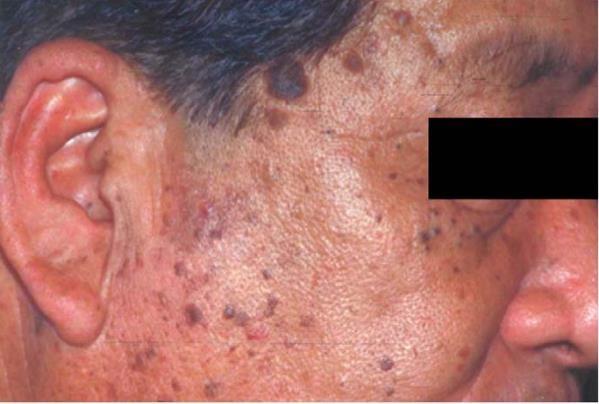
In composting, the quality of materials is a major factor in the quality of compost produced. Contaminated materials have the potential to produce pollutants. In the United States, pentachlorophenol containing PCDDs and PCDFs were found in compost, which was later found to be derived from the raw materials. For example, compost from yard residues may contain PCPs if wood chips have been treated with the material. Here is a picture of incinerator workers in Japan who were exposed to PCBs (Figure 1); even Ukraine's president Viktor Yushchenko was affected by chloracne due to TCDD contamination (Figure 2).
 |
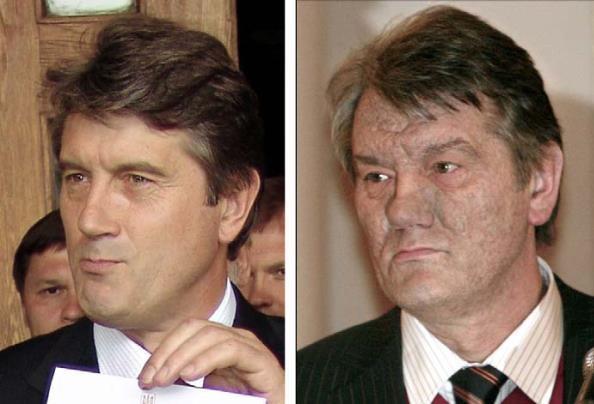 |
| Figure 1. Chloracne and hyperpigmentation on the face of an incinerator worker | Figure 2. President Viktor Yushchenko of Ukraine before and after exposure to 2,3,7,8-TCDD dioxin. |