


.webp)
DELI SERDANG — Universitas Sumatera Utara (USU), through its TALENTA 2026 Community Service Program, is promoting women’s economic independence by empowering housewives in Suka Maju Village, Sibolangit District, Deli Serdang Regency, North Sumatra.
YouTube :
Carrying the theme “Building an Entrepreneurial Mindset among Housewives in Suka Maju Village, Sibolangit,” the initiative aims to encourage women to recognize local resources as opportunities for productive business development. One of the key local commodities being developed is corn, which has traditionally been sold primarily in its raw form.
The community service program is titled “Strategies for Strengthening Women’s Economic Resilience through the Transformation of Corn into Food Flour Products in the Post-Disaster Context in Suka Maju Village, Sibolangit.” The program is funded through Universitas Sumatera Utara’s Non-Tax State Revenue (Non-PNBP) allocation, managed by the USU Institute for Research and Community Service (LPPM), for the 2026 fiscal year.
Transforming Local Potential into Business Opportunities
Suka Maju Village has significant agricultural potential, particularly in corn, which can be developed into a source of additional economic value for the community. However, dependence on selling raw corn limits the added value received by farmers and leaves their businesses vulnerable to price fluctuations and distribution disruptions.
This issue became even more critical following the floods and landslides in late 2025, which disrupted road access and the distribution of agricultural products in several areas, including the Sibolangit region.
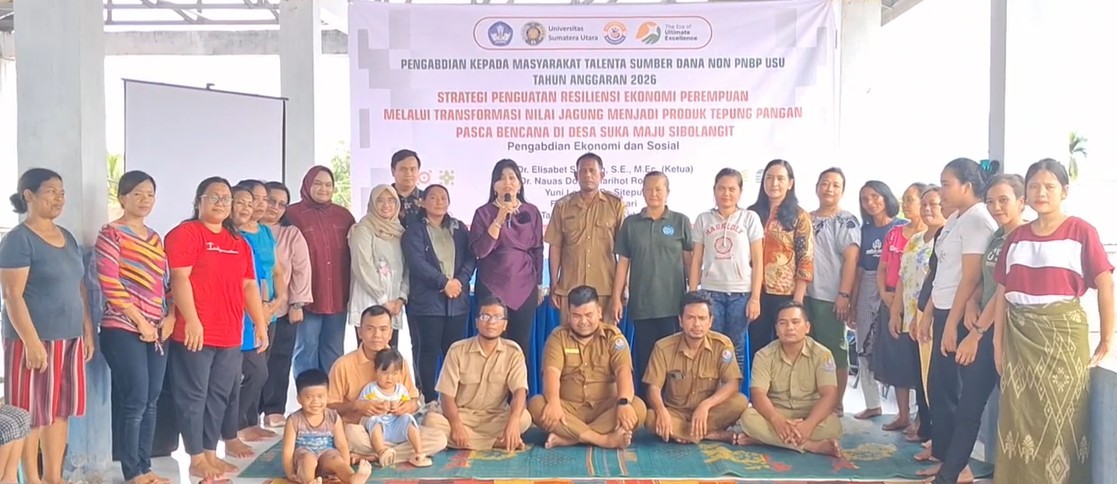
Through this program, the USU community service team is encouraging a shift in entrepreneurial thinking—from simply selling agricultural produce to processing locally available raw materials, creating value-added products, and developing businesses managed collectively.
The Family Welfare Movement (PKK) women’s group in Suka Maju Village serves as the program’s primary community partner. Women are positioned not merely as training participants but as key actors expected to develop the potential of corn into productive economic activities that benefit their families and the wider village community.
Applying Appropriate Technology and Product Diversification
One of the program’s key initiatives is introducing corn processing into food flour through the use of appropriate technology, including corn-drying and corn-milling machines.
These technologies are intended to reduce dependence on traditional sun-drying methods, maintain raw material quality, and support a more efficient and consistent flour production process.
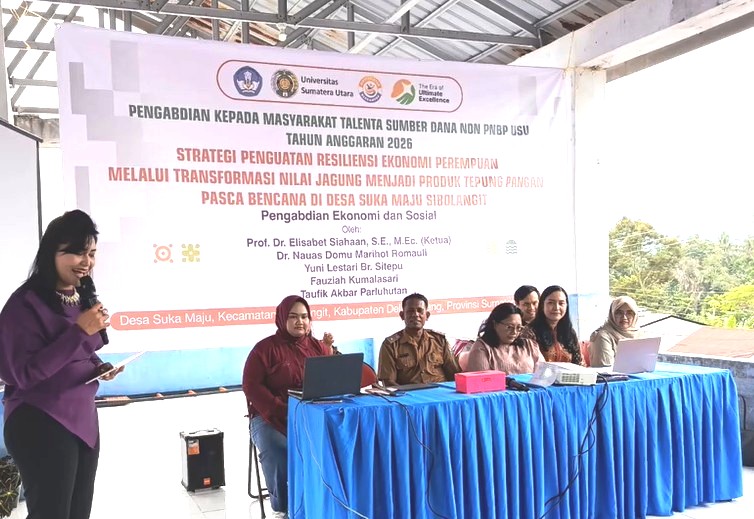
Business development does not stop at producing corn flour. The program also opens opportunities for diversifying food products, including cipera, cimpa jagung, gulame jagung, corn pudding, corn chips, corn sponge cake, and other corn-based products.
Through this diversification, corn is expected to serve a wider range of purposes. Corn flour can be used as an ingredient in various food products, potentially reaching broader market segments and generating greater added value than selling raw corn.
In addition to production, developing product identity through branding, logos, and packaging is an integral part of preparing these products to be more recognizable to consumers and more competitive in the marketplace.
Building an Entrepreneurial Mindset and Business Management Skills
The USU TALENTA 2026 Community Service Program integrates food-processing skills with business management and accounting training. This approach is essential to ensure that women’s groups not only acquire the ability to produce goods but also understand how to operate a business systematically and effectively.
The mentoring sessions cover production planning, production cost identification, calculation of the Cost of Goods Manufactured (COGM), Break-Even Point (BEP) analysis, selling price determination, basic financial recordkeeping, and cash flow management.
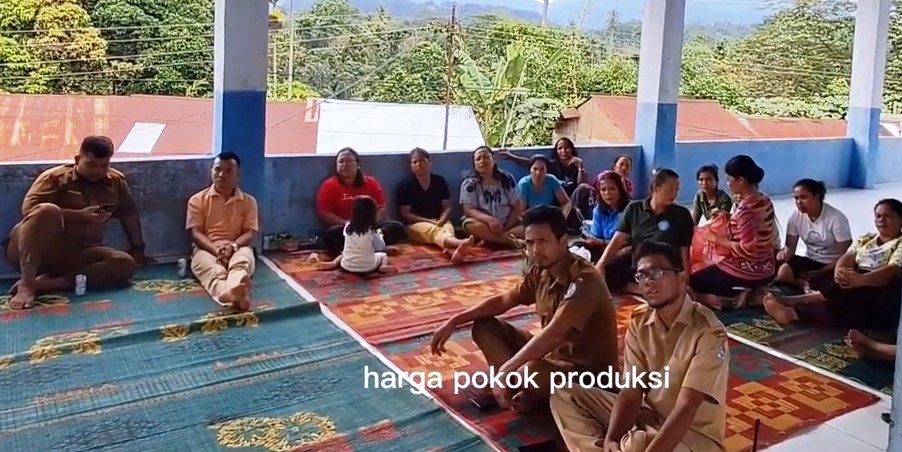
By strengthening these competencies, participants are expected to distinguish sales revenue from business profit, determine appropriate selling prices based on production costs, and manage their finances to ensure business continuity.
The program also seeks to establish a collaborative working system by distributing responsibilities across production, finance, and marketing. As a result, the businesses developed are expected to operate through collective management rather than depending on a single individual, enabling more structured and sustainable operations.
Preliminary Results Indicate Improved Participant Capacity
According to the program’s progress report, an evaluation of 13 participants using eight indicators on a five-point Likert scale showed an average understanding score of 3.27 out of 5.
Participants achieved the highest average score in identifying production costs, at 3.46. Meanwhile, their understanding of COGM calculation received an average score of 3.00, indicating that this area requires further mentoring.
These findings suggest that participants have developed a foundational understanding of business management. However, their ability to apply these skills independently still needs to be strengthened through practical exercises using actual production data and transaction records.
Accordingly, the next phase of the program will focus on strengthening the application of appropriate technology, developing derivative food products, improving packaging, expanding market access, assisting with product legality requirements, and strengthening the institutional capacity of the business group.
Promoting Sustainable Women’s Economic Independence
The community service team is led by Prof. Dr. Elisabet Siahaan, S.E., M.Ec., with team members Dr. Nauas Domu Marihot Romauli, S.TP., M.Eng.; Yuni Lestari Br Sitepu, S.E., M.Si.; Fauziah Kumalasari, S.E., M.Ak.; and Taufik Akbar Parluhutan, S.E., M.Si.
The program aligns with the Sustainable Development Goals (SDGs), particularly SDG 5: Gender Equality, SDG 8: Decent Work and Economic Growth, and SDG 2: Zero Hunger, through the development of local food resources.
Through interdisciplinary collaboration and direct community engagement, USU seeks to encourage rural women to take on a greater role in the economic value chain, from raw material processing and product development to packaging, marketing, and business financial management.
Ultimately, the program’s success will not be measured solely by the ability to produce corn flour, but also by the women’s group’s capacity to manage its business independently and sustainably.
From local corn to value-added products, from practical skills to business opportunities, and from women’s empowerment to family economic independence. This is the spirit that the USU TALENTA 2026 Community Service Program seeks to foster in Suka Maju Village, Sibolangit.