


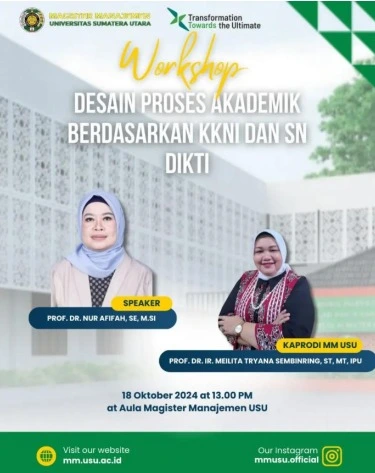
Medan, October 18, 2024 — The Master's Program in Management of Universitas Sumatera Utara (MM USU) held a Workshop on Academic Process Design Based on the Indonesian National Qualifications Framework (KKNI) and the National Standards of Higher Education (SN DIKTI). The event took place at the MM USU Auditorium starting at 1:00 PM local time, attended by lecturers and education staff within the study program.
The workshop featured Prof. Dr. Nur Afifah, S.E., M.Si. as speaker, with opening remarks and direction from the Head of the MM USU Study Program, Prof. Dr. Ir. Meilita Tryana Sembiring, S.T., M.T., IPU. In her remarks, she emphasized the importance of implementing KKNI and SN DIKTI as the primary foundation for curriculum development and academic processes in higher education, so that graduates possess competencies that are relevant and nationally recognized.
The topics covered included the formulation of Graduate Learning Outcomes (CPL), the development of competency-based curricula, and the design of learning processes aligned with national standards. In addition to the presentation of materials, participants also took part in discussion sessions and hands-on practice in designing academic processes suited to their respective fields of study, allowing the results of the workshop to be applied directly to curriculum development within the study program.
Through this activity, participants gained a deeper understanding of the implementation of KKNI and SN DIKTI, while also strengthening their ability to design learning processes that bridge the academic world with the needs of the workforce. The outcomes of the workshop are expected to drive improvements in curriculum quality and learning processes, as well as strengthen the competitiveness of MM USU graduates at both national and international levels.
This activity aligns with several Sustainable Development Goals (SDGs). The development of academic processes based on KKNI and SN DIKTI reflects USU's genuine commitment to supporting SDG 4 – Quality Education by ensuring the quality of higher education is inclusive, relevant, and in line with national standards, while also strengthening lecturers' capacity as educators. Aligning learning outcomes and curricula with workforce needs also contributes to SDG 8 – Decent Work and Economic Growth, as it aims to prepare graduates who are competent and ready to compete in the labor market. In addition, strengthening innovative academic systems and processes supports SDG 9 – Industry, Innovation, and Infrastructure, through the strengthening of higher education infrastructure based on national standards.
Through this workshop, the MM USU Study Program reaffirms its commitment to continuously improving the quality of higher education while contributing to the achievement of the Sustainable Development Goals (SDGs) within the campus environment.